Features
What can you do with our plugin?
Completely Free
Manually add FAQ Schema to any page or post.
Quick site-wide report to spot missing SEO signals.
Manage Alt/Title/Caption/Description with a built-in report.
Review Yoast titles, keywords, and meta descriptions in one place.
Advanced AI
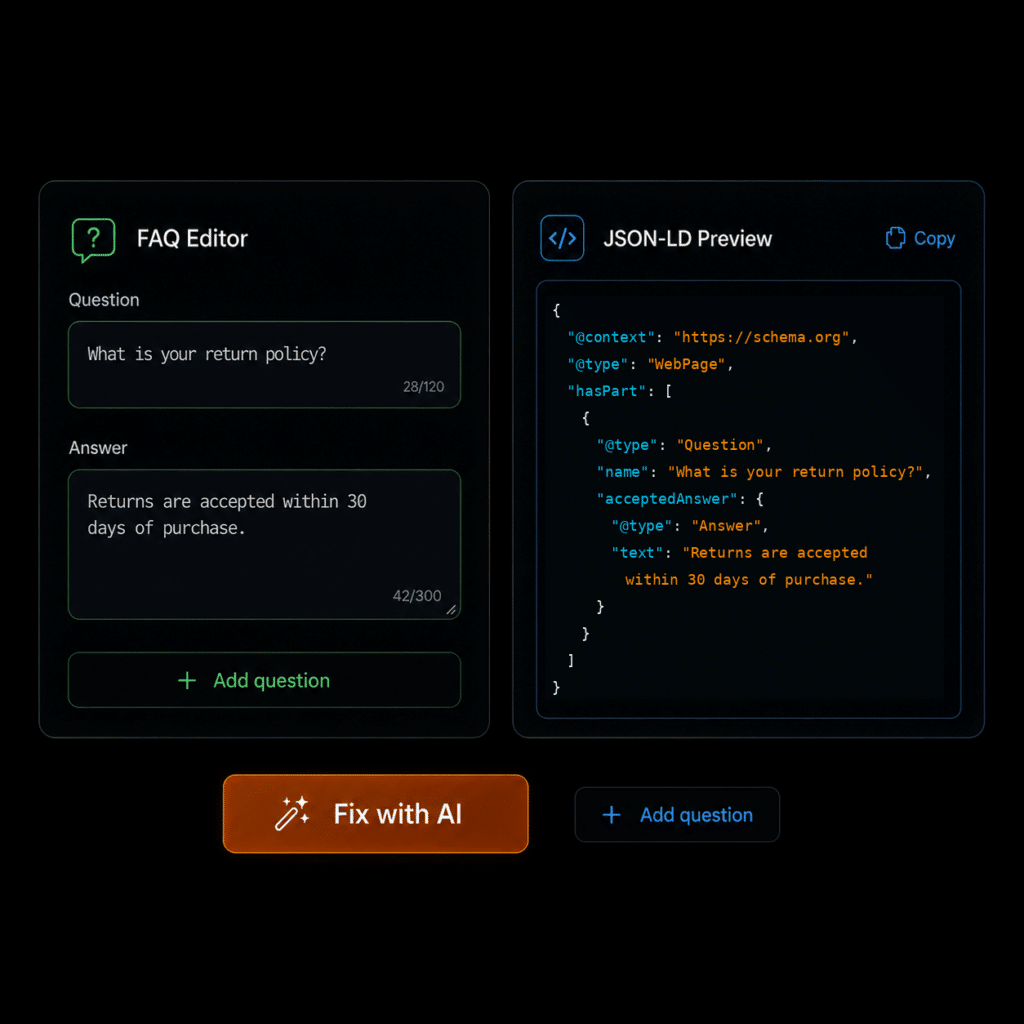
Auto generated FAQ Schema from your page content with AI.
Generate structured drafts - on demand or on a schedule.
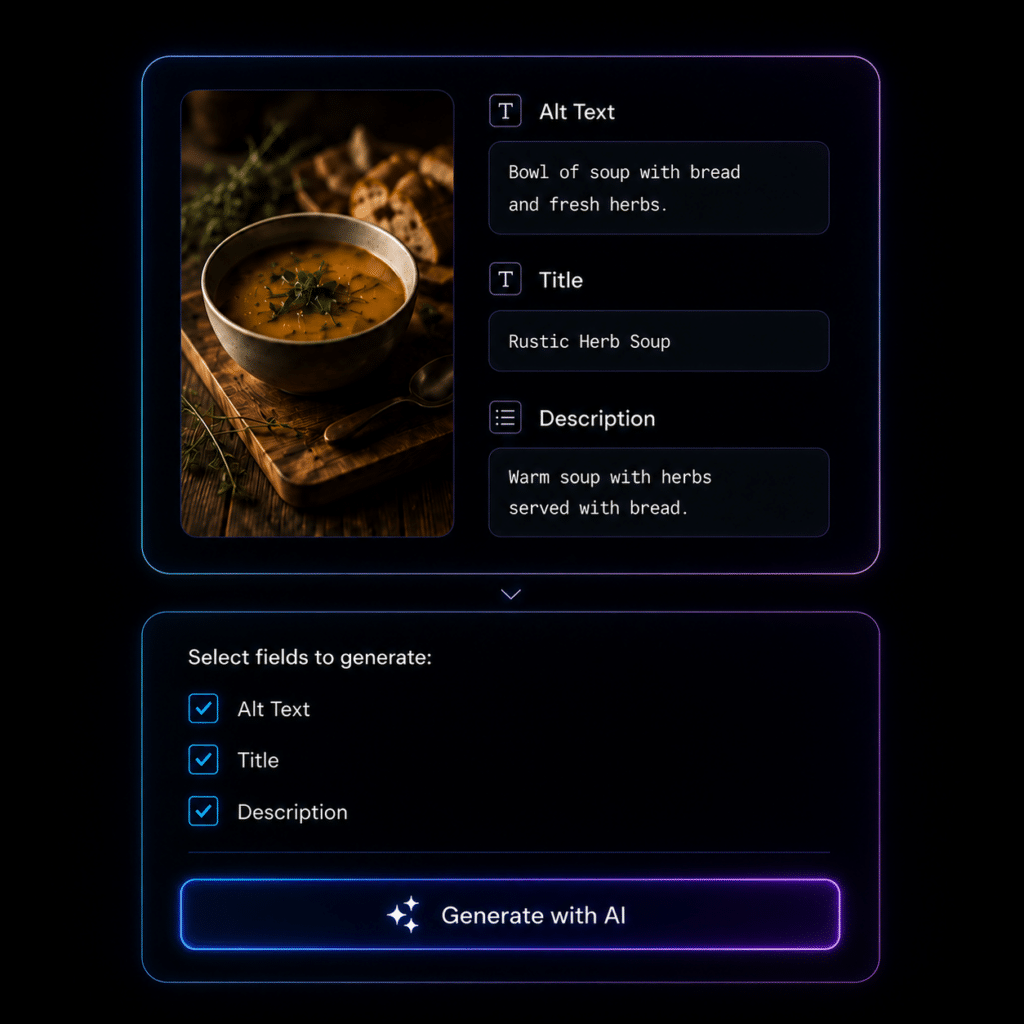
Generate Alt/Title/Caption/Description automatically per image.
Generate realistic featured images for posts, pages, and CPTs.
Explore all Features
FAQ Schema Generation (Pages, Posts & CPTs)
This feature is a true game-changer for the AI era. It adds FAQ Schema (Rich Results) to your pages and posts – code only (behind-the-scenes ) or visible to visitors with a shortcode – transforming your content into a clear Q&A structure that search engines and AI systems can easily understand. That structured format is easier to extract, reference, and summarize, which can improve AI discovery (GEO) and modern search visibility. In other words, you gain the benefits of Rich Results-ready structured data without changing your page design.
00:00: This tutorial shows how to add manual FAQ schema to a WordPress post. You will learn
00:05: to insert and fill questions and answers within your post editor.
00:09: Click any post or page to open the post editor for that article.
00:13: Click "Drag to resize" to adjust the size of the editing pane for better visibility.
00:19: Click "+ Add manual question" to start adding a custom FAQ question to your post.
00:25: Fill "Question here" with the text of your first FAQ question to provide information
00:28: to readers.
00:30: Fill "Answer here" with the answer corresponding to your FAQ question to clarify
00:34: details for readers.
00:37: Click "+ Add manual question" to add a second custom FAQ question to your post.
00:42: Fill "Question 2 here" with the text of your second
00:45: FAQ question to expand your FAQ section.
00:49: Fill "Aswer 2 here" with the answer to your second FAQ
00:51: question to provide helpful information.
00:55: Click "Save" to save all your changes and update the post with the new FAQ questions
00:59: and answers.
01:01: You have successfully added manual FAQ questions and answers to your WordPress post
01:05: and connected
01:06: the AI Cloud Service for automatic FAQ generation.
01:09: Your post is now updated with enhanced content to assist readers and improve
01:13: engagement.
00:00: This tutorial shows you how to generate AI-powered FAQ Schema directly from your
00:04: post content.
00:06: Click any post or page to open the post editor for that article.
00:10: Click "Generate FAQ with AI" to automatically create frequently asked questions
00:14: related to your post content using WordPress's AI feature.
00:19: This is where the magic happens: within a few seconds,
00:22: the AI will scan your post or page content and generate up to 10 relevant FAQs
00:27: automatically.
00:29: Click "Save" to apply all changes to your post, including the newly approved AI-generated
00:33: FAQ.
00:36: All done!
00:37: Turning your content into a clear FAQ structure that search engines and AI systems
00:42: can easily understand can help improve your site’s visibility and attract more
00:47: visitors.
00:00: This tutorial guides you through
00:01: configuring the base AI content writer settings and connect your API key to
00:06: enhance your website's functionality.
00:09: Enter into the ByTheWeb AI main setting page.
00:13: Add your site or business name on the first input.
00:17: Add a short description of your website or business here to help the AI understand
00:20: your business and generate relevant content for your services and areas of
00:24: expertise.
00:26: Select your default WordPress post category
00:28: for AI-generated articles.
00:31: New articles will be assigned to this category automatically.
00:35: Here it gets really interesting:
00:36: you can add SEO keywords and assign a URL to each one.
00:41: The AI-generated articles will automatically use them to create internal links across
00:45: your site and strengthen your SEO strategy.
00:50: Click "Add Link" to add another SEO link to your configuration.
00:53: You can add up to 10 SEO links and keywords.
00:58: Click "Save Changes" to apply all your SEO settings and links.
01:02: Ones complete, Click "API Connection & Credits" to access the API integration
01:07: settings from your ByTheWeb AI.
01:11: Click the "Free Sign Up" to get your API key and claim your 7,000 free AI credits.
01:17: Complete your registration on our website to receive your API key.
01:20: No credit card or payment is required.
01:23: Click "Get API Key" to generate your unique API key and get your welcome Email.
01:29: Copy your API key.
01:32: Paste your API Key back on your site.
01:35: And Click "Save" to complete the integration process.
01:38: You have successfully configured SEO settings and integrated
01:41: the API key into your WordPress site. This setup enhances your website's search
01:46: optimization and enables advanced features through API connectivity.
Why this matters?
- SEO: better image relevance, improved on-page context, and stronger content signals
- Accessibility: Alt text improves usability for screen readers
- GEO: clearer visual context helps AI systems interpret and reference your content more accurately
What’s Free?
- Manually add and edit FAQs on any page, post, or custom post type
- Full control: create, update, reorder, and remove Q&A items
- Keep your content clear, structured, and easy to scan.
What’s with Credits?
- Automatically AI generate FAQ suggestions based on the existing page/post content
Site Analysis + Dashboard Alerts
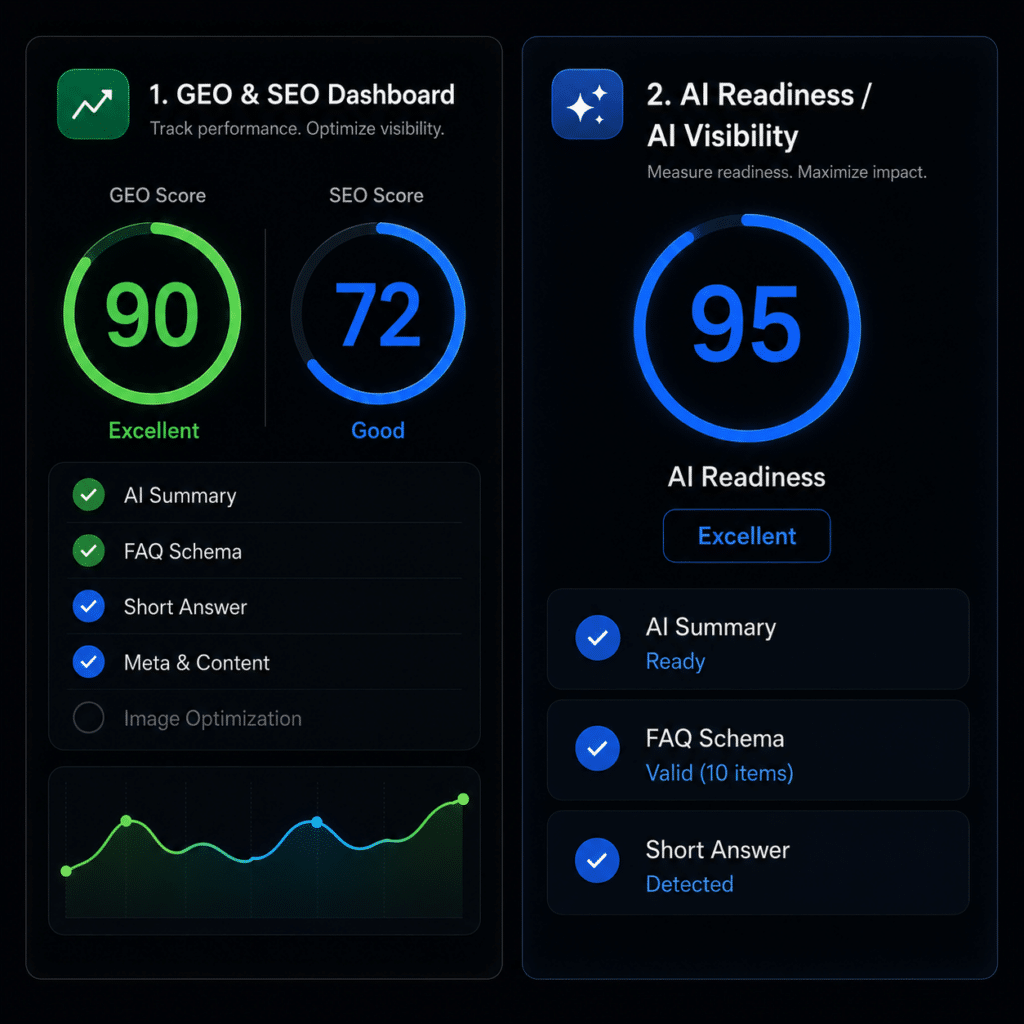
Site Analysis gives you a clear, centralized snapshot of your website’s content health – in seconds. Instead of manually checking pages one by one, you get an organized report that highlights missing or incomplete site elements that impact SEO, GEO (AI readability), and overall content quality. It’s designed to be practical: you immediately see what’s missing, where it’s missing, and what to fix first. The built-in dashboard alerts make it even easier by surfacing issues directly inside WordPress, so you don’t forget them and you can keep improving the site over time.
00:00: This tutorial guides you through analyzing and optimizing your WordPress site's SEO
00:04: performance.
00:05: You will learn how to identify missing FAQs, fix meta optimization issues, and edit
00:11: focus keyphrases to improve your site's search visibility.
00:15: Click "Site Analysis" to open the main SEO and GEO site audit dashboard.
00:20: Visit "Missing FAQ on Posts list" section to view posts
00:24: lacking frequently asked questions. This helps identify content gaps that can
00:28: improve user engagement, GEO and SEO.
00:32: Visit "Missing FAQ on Pages list" section to view pages without FAQ sections.
00:37: Addressing these can enhance page relevance and user experience.
00:42: Visit "Meta Optimization on
00:48: Posts list" to view review posts with meta optimization issues. Click "Edit" to Fixing these improves how search engines interpret your content.
00:54: Click "Meta Optimization on Pages list to identify pages needing meta optimization
00:58: improvements.
00:59: This step ensures consistent SEO quality across your site.
01:04: You have successfully analyzed missing FAQs and meta
01:07: optimization issues, accessed the SEO audit, and edited the focus keyphrase to enhance your
01:12: WordPress site's SEO.
01:14: These steps help improve your site's search visibility and content quality for better
01:18: user engagement.
Why this matters?
- Helps you spot missing content signals that reduce visibility in search and AI discovery
- Improves “machine readability” by encouraging clearer structure and complete metadata
- Keeps site-wide quality consistent as the site grows
What’s Free?
- Centralized site analysis report inside WordPress
- Detects missing or incomplete content elements (for example: missing image data, FAQ coverage, and key meta fields)
- Dashboard alerts/badges that highlight issues and keep them visible
- A cleaner workflow for prioritizing and fixing problems across pages, posts, and CPTs
AI Article Wizard (Content Generation)
This is your full “content production workflow” inside WordPress – not just a text generator. The AI Article Wizard helps you turn a topic into a ready-to-publish post with a clear structure, better readability, and content that’s easier for both search engines and AI-based systems to understand. In the GEO era, structure is everything: when your content is organized, explicit, and well-formatted, it becomes far more accessible to AI discovery and referencing. The Wizard also connects naturally with your strongest supporting features – like FAQ generation and a featured image – so you can publish complete, professional pages faster, with full editorial control.
00:00: This tutorial guides you through creating an AI-generated article using the WordPress
00:03: Dashboard.
00:06: You will learn how to generate content, customize settings, and publish your article
00:10: effectively.
00:12: Before you begin, make sure you have a valid API kay installed on your site.
00:17: You can get it for free from the "API Connection & Credits" page from the ByTheWeb AI menu.
00:21: AI menu.
00:23: Once your API key is ready, configure the basic settings for your AI Content Writer.
00:28: on the ByTheWeb AI menu, click "Settings".
00:32: In the main Settings area, under the "Article Settings" tab, enter your website or
00:37: business name and description.
00:40: This helps the AI get to know your site and create more relevant content for you.
00:45: After that, set the in-article heading style and choose the
00:47: default WordPress post category for AI-generated articles. New articles will be assigned to
00:53: this category automatically.
00:56: In the "Internal Links" section, you can add up to 10 SEO keywords with matching URLs.
01:00: AI-generated articles will randomly use them to create internal links across your site
01:05: and strengthen your SEO strategy.
01:08: Click "Save Changes" and you are good to go.
01:12: Ones settings are saved,
01:13: Hit the "New AI Article" from the ByTheWeb AI site menu, to begin creating a new article using
01:17: AI assistance.
01:20: Create Articles in 4 Easy Steps: Topic, Settings & SEO, Article Generation, and
01:26: Featured Image Generation
01:28: Start with "Get Article Ideas from AI" to explore topic suggestions generated by the
01:33: AI.
01:34: You can click it repeatedly until you find the topic you want.
01:38: Select one of your desired topic suggestions.
01:42: Or add one manually.
01:44: on the next step, you can choose the writing tone for your article, such as
01:48: "Professional and Authoritative," "Light and Friendly," "Marketing and Action-Oriented," or
01:53: "Informative."
01:55: on the next step, review your selections and click "Generate Article Now" to allow the
01:59: AI to generate your article content.
02:02: Within about a minute, your new article will be ready.
02:06: The final step is optional.
02:08: You can use AI to generate a featured image for the post.
02:11: The prompt fields are automatically filled with suggested text based on your new
02:15: article content,
02:16: you can edit them before clicking "Generate Featured Image with AI."
02:21: Within a few seconds,
02:22: your new AI-generated image will be ready.
02:26: If you’re happy with it, save it.
02:27: If not, you can try again.
02:30: Once you save it, the AI will also complete the image SEO text fields
02:33: automatically,
02:34: so nothing is left blank. Review them if needed, then click "Save" to finish.
02:40: Process completed successfully! Your new article is ready!
02:44: Hit the "Edit and Publish Article" to open the article editor for final adjustments
02:48: before publishing.
02:50: Now it’s time to read and review your new article, including the automatically
02:53: generated FAQs, internal links, and post tags.
02:57: Make any edits you need,
02:59: then publish it to your site.
03:02: Great job
03:02: — your AI-powered article is now live on your WordPress
03:05: site. You can keep creating content anytime with the AI Wizard, or enable ByTheWeb AI Auto Pilot
03:11: to start generating new articles for you automatically based on your selected
03:15: schedule.
Why this matters?
- Helps you publish structured content that is easier to scan, summarize, and reference
- Improves clarity and intent, which supports both SEO ranking signals and AI-readability
- Turns content creation into a repeatable workflow instead of a one-off task
What’s with Credits?
- Generate a structured article draft directly inside WordPress
- Improve readability and flow with clear sections and formatting
- Generate an FAQ block based on the article/page content
- Generate a realistic featured image for the post (optional) and set it as the featured image
- Review and edit everything before publishing – you stay in control
Auto Pilot (Automated Content Workflow)
Auto Pilot is the “done-for-you” version of the AI Article Wizard. It uses the same AI content workflow, but adds automation layers that work for you in the background: scheduling, topic queues, and optional auto-publishing. Instead of generating content only when you have time to sit down and create it, Auto Pilot helps you maintain consistency – producing structured drafts (and optional enhancements featured images) on a predictable routine. This is especially powerful in the GEO era, where consistent, well-structured publishing improves how search engines and AI systems understand your site over time.
00:00: This tutorial guides you through setting up Auto Pilot to automatically
00:03: generate articles using AI on your WordPress site.
00:07: You will learn how to enable the feature, select publishing frequency, suggest topics,
00:11: and save your settings for seamless content creation.
00:15: From the ByTheWeb AI site menu, Click "Auto Pilot" to open the Auto Pilot
00:19: configuration page on your WordPress dashboard.
00:23: Click "Enable Auto Pilot for automatic article generation with AI" to activate
00:27: the Auto Pilot functionality for your site.
00:31: Choose how often new articles should be published: twice a week, once a week, once
00:36: every two weeks, or once a month.
00:39: In the "Topics" section, click "Suggest Topics" to get AI-generated topic ideas for your articles.
00:43: You can click it repeatedly to generate more suggestions.
00:49: Choose a topic for your new articles, or add your own manually.
00:54: The selected topics will be added to the "Topic Queue" list, where you can delete or
00:58: reorder them as needed.
01:00: Set this option to "On" if you wish to automatically generate a featured image for
01:04: each new article as well.
01:07: Click "Automatically publish articles" to allow articles to be published without
01:11: manual intervention.
01:13: Click "Save Auto Pilot Settings" to store your configuration and apply the
01:17: Auto Pilot settings.
01:20: Auto Pilot is now set up to automatically generate and publish AI-powered
01:24: articles on your WordPress site. You’ll also receive an email each
01:28: time a new article is created.
Why this matters?
- Consistent publishing strengthens topical authority and keeps the site fresh
- Automated, structured drafts are easier for AI systems to parse and reference
- Reduces the “content bottleneck” while keeping human control available
What’s with Credits?
- Automated article creation using the same guided workflow as the AI Article Wizard
- Scheduling controls (run on a routine instead of manual one-offs)
- Topic queue management (plan content in advance and let it run)
- Draft or auto-publish modes (you decide the level of automation)
- Optional enhancements per run: FAQs and a realistic featured image
- Notifications and activity history, so you can track what was created and when
Media Optimization (Alt, Title, Caption & Description)
Images are one of the most overlooked SEO assets on a WordPress site – and they’re also a major “blind spot” for AI systems when metadata is missing or inconsistent. Media Optimization turns your image library into structured, searchable, AI-readable content by helping you maintain meaningful Alt text, titles, captions, and descriptions. The result is stronger accessibility, clearer context for search engines, and better discoverability for AI-driven search experiences that rely on clean, descriptive signals to understand what your pages contain.
00:00: This tutorial guides you through optimizing media metadata to improve your website's
00:04: SEO and accessibility.
00:07: You will learn how to add descriptive information to your images for better search
00:10: engine recognition.
00:11: Click "Media Optimization" to open the media settings area where you can enhance your
00:16: image metadata.
00:18: Click here to access the detailed settings for the selected image within the Media
00:22: Optimization page.
00:24: Enter your image's ALT text to provide a descriptive alternative for screen readers
00:28: and improve SEO.
00:30: Fill in the title field to give your image a clear and concise title that appears
00:33: on hover and in search results.
00:37: Enter an image caption to display descriptive text below the image on your
00:41: website,
00:41: enhancing user understanding.
00:45: Fill in the full image description to offer detailed information about the image
00:49: content for accessibility purposes.
00:52: Click "Save Changes" to apply all your updates and optimize the media metadata
00:56: effectively.
00:58: You have successfully optimized your media metadata by adding ALT text, titles,
01:02: captions, and descriptions to your images.
01:05: This enhances your website's SEO and accessibility, ensuring better user experience
01:11: and search engine recognition.
00:00: This tutorial guides you through optimizing media files on your WordPress site using
00:04: AI-powered tools.
00:06: You will learn how to generate, approve, and save optimized media efficiently.
00:11: Click "Media Optimization" to open the media optimization settings in your WordPress
00:15: dashboard.
00:17: Click "Generate with AI" to start the AI-based media optimization process.
00:23: Within a few seconds, the image will be scanned and the content will be added to the
00:27: correct fields automatically.
00:29: Click "Save Changes" to apply and save the approved media optimizations.
00:35: You can run this again for every image that needs improvement.
00:39: You have successfully optimized your media files using AI tools within the ByTheWeb AI
00:43: dashboard. Your media
00:44: is now enhanced and saved, improving site performance and user experience.
Why this matters?
- SEO: better image relevance, improved on-page context, and stronger content signals
- Accessibility: Alt text improves usability for screen readers
- GEO: clearer visual context helps AI systems interpret and reference your content more accurately
What’s Free?
- Quickly review and manage key image fields (Alt, Title, Caption, Description)
- Manually edit metadata to match your page context and brand language
- Improve consistency across your media library
What’s with Credits?
- Generate optimized Alt/Title/Caption/Description automatically for selected images
- Create context-aware metadata that matches the page/topic (not generic filler)
- Standardize your media library faster while keeping human review and editing control
- Improve overall “machine readability” of your site’s visual content
Featured AI Image Generator + Image SEO Texts
A strong featured image is more than design – it’s a key part of how people (and machines) understand and trust your content. This feature generates a realistic featured image that matches the article topic, then helps you finalize the image with proper SEO text fields. The result is a post that looks professional immediately, and a media asset that carries clearer context signals for search engines and AI systems – supporting both visibility and consistency at scale.
00:00: This tutorial guides you through adding a featured image to your WordPress post
00:03: using AI-generated content.
00:06: You will learn how to generate, approve, and save the image to enhance your post's
00:11: visual appeal.
00:12: On your edit post page,
00:13: Click "Featured Image with AI" to open the AI image generation tool
00:19: In the pop-up window, add your image subject and environment,
00:23: and even choose the camera angle or point of view.
00:27: Click "Generate Image Now" to create an AI-generated image for your post.
00:32: Your new AI generated image is ready!
00:35: If you’re happy with it, save it.
00:37: If not, you can try again.
00:40: Once you save it, the AI will also take care of the image SEO text fields,
00:44: so nothing is left blank.
00:47: Click "Save" to ensure all your edits, including the featured image, are saved
00:51: successfully.
00:53: You have successfully added an AI-generated featured image to your WordPress post and
00:57: saved the changes. This
00:58: enhances your post's visual appeal and engages your audience effectively.
Why this matters?
- A strong featured image boosts trust, attention, and click-through on your content
- Keeps posts looking professional and consistent without slowing down publishing
- Image SEO texts (alt/title/caption/description) add clear context signals for search engines
- Improves accessibility by providing meaningful alt text for screen readers
What’s with Credits?
- Generate a realistic featured image based on an AI-prepared description (editable before generation)
- Approve and set as the post’s featured image in one click
- Save to media and retry if needed
- Edit the image SEO fields (alt/title/caption/description) before saving
SEO Audit (Yoast)
SEO across a WordPress site often breaks down not because you don’t know what to do — but because it’s hard to see everything at once. The SEO Audit feature gives you a clean, centralized view of your Yoast SEO data across your entire site: pages, posts, and custom post types. In one table, you can review each item’s SEO title, focus keyword, and meta description, instantly spot what’s missing, and keep metadata consistent across the website. It’s a simple but highly effective workflow upgrade that saves time, reduces mistakes, and helps you maintain strong SEO fundamentals at scale.
00:00: This tutorial guides you through accessing key SEO audit sections within your
00:04: WordPress dashboard.
00:06: You will learn how to navigate to the SEO Audit, Pages, and Posts areas to manage your
00:11: website's SEO effectively.
00:13: From the ByTheWeb AI site menu, Click "SEO Audit" to open the SEO audit overview in your
00:17: WordPress dashboard. This section
00:19: provides insights into your website's search engine
00:22: optimization status.
00:25: The SEO Audit feature gives you a clean, centralized view of your SEO data across
00:29: your entire site: pages, posts, and custom post types.
00:33: In one table, you can review each item’s SEO title, focus keyword, and meta
00:38: description.
00:40: Instantly spot what’s missing, and keep metadata consistent across the website.
00:45: It’s a simple but highly effective workflow upgrade that saves time.
Why this matters?
- Quickly find missing or incomplete Yoast fields across the site
- Improve consistency between pages (titles, keywords, descriptions)
- Prioritize fixes and avoid “forgotten” pages with empty metadata
- Keep your SEO hygiene clean without opening dozens of editors
What’s Free?
- Centralized audit table for Yoast SEO fields (Title / Focus Keyword / Meta Description)
- Works across Pages, Posts, and Custom Post Types
- Clear “Missing” indicators to highlight what needs attention
- Quick “Edit” actions to jump directly into updates
Requirement
- This feature reads SEO fields from the Yoast SEO plugin only
- Yoast must be installed and active to use this overview
SEO Overview (Yoast Titles, Keywords & Meta Descriptions)
Managing SEO across a full WordPress site is usually scattered and frustrating: you jump between pages, open editors, and hunt for missing titles, keywords, or meta descriptions. This feature solves that by giving you a single, centralized table that shows your Yoast SEO fields across the entire website — pages, posts, and custom post types — all in one place. It’s a simple but powerful workflow upgrade: you instantly spot what’s missing, compare consistency, and jump directly to edit — saving time and keeping your SEO fundamentals clean and organized.
00:00: This tutorial guides you through analyzing and optimizing your WordPress site's SEO
00:04: performance.
00:05: You will learn how to identify missing FAQs, fix meta optimization issues, and edit
00:11: focus keyphrases to improve your site's search visibility.
00:15: Click "Site Analysis" to open the main SEO and GEO site audit dashboard.
00:20: Visit "Missing FAQ on Posts list" section to view posts
00:24: lacking frequently asked questions. This helps identify content gaps that can
00:28: improve user engagement, GEO and SEO.
00:32: Visit "Missing FAQ on Pages list" section to view pages without FAQ sections.
00:37: Addressing these can enhance page relevance and user experience.
00:42: Visit "Meta Optimization on
00:48: Posts list" to view review posts with meta optimization issues. Click "Edit" to Fixing these improves how search engines interpret your content.
00:54: Click "Meta Optimization on Pages list to identify pages needing meta optimization
00:58: improvements.
00:59: This step ensures consistent SEO quality across your site.
01:04: You have successfully analyzed missing FAQs and meta
01:07: optimization issues, accessed the SEO audit, and edited the focus keyphrase to enhance your
01:12: WordPress site's SEO.
01:14: These steps help improve your site's search visibility and content quality for better
01:18: user engagement.
Why this matters?
- Quickly identify missing SEO titles, focus keywords, and meta descriptions
- Keep site-wide SEO consistent (especially on large sites with many pages)
- Reduce the chance of “forgotten” pages with empty metadata
What’s Free?
- Centralized overview of Yoast SEO data across pages/posts/CPTs
- Clear indicators for missing fields (so you know what to fix first)
- Quick “Edit” actions to jump directly into updates
Requirement
- This feature reads SEO fields from the Yoast SEO plugin only
- Yoast must be installed and active to use this overview