
Skip to Main Content Enable / Disable keyboard navigation (ENTER key) Accessible Menu Accessibility panel Reset accessibility Sitemap Accessibility statement
AI Visibility & GEO Readiness

llms.txt & llms-full.txt Files

With ByTheWeb GEO Plugin
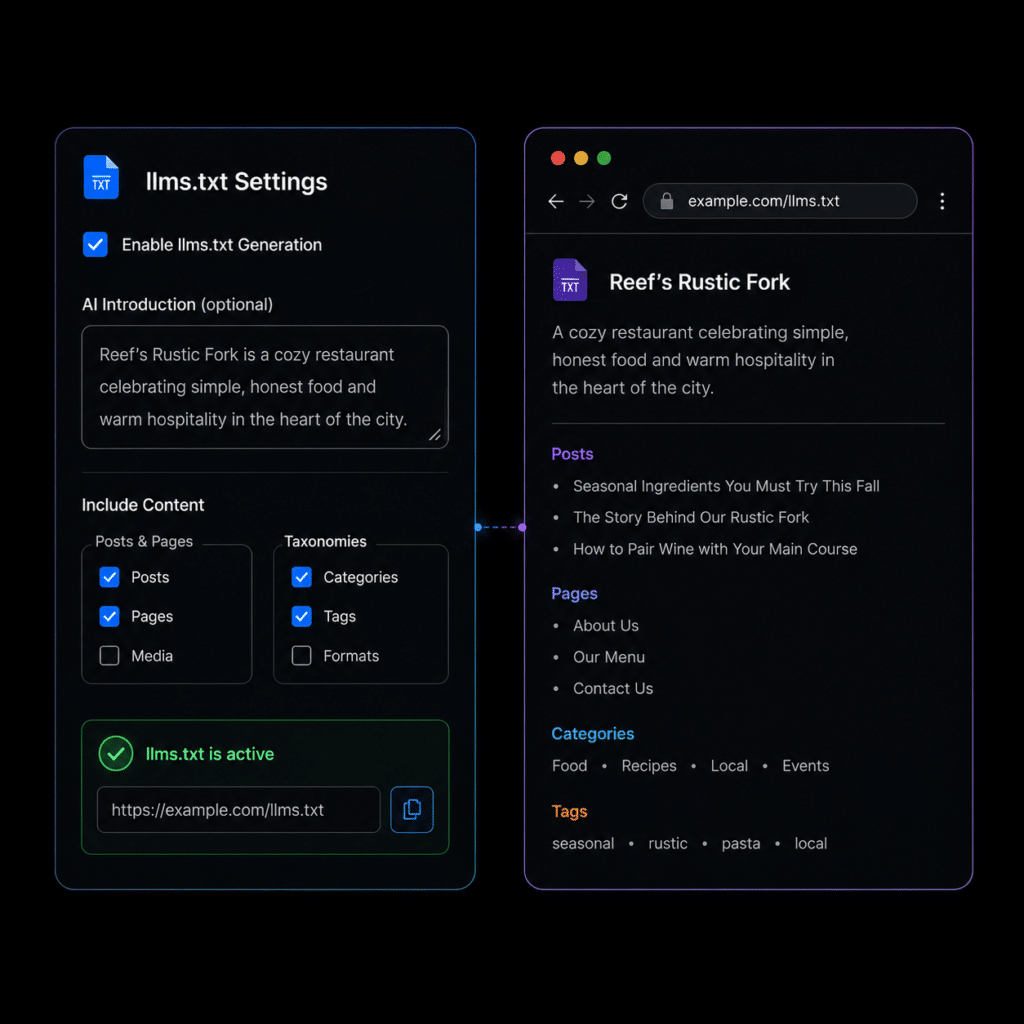
Help AI engines understand your website faster with clean, structured Markdown files built for Large Language Models. ByTheWeb GEO automatically generates an AI-readable llms.txt index, and can also create an optional llms-full.txt file with a fuller version of your public, indexable content – including Short Answers, AI Summaries, cleaned page content, taxonomy descriptions, and important links.
Tech Skill Needed:
FREE
Easy
llms.txt & llms-full.txt Files


Traditional search engines rely on links, metadata, and sitemaps. Modern AI engines also need clean context they can quickly read, summarize, and trust.
ByTheWeb GEO creates dedicated AI-readable files for that purpose. The llms.txt file works as a concise guide to your website, highlighting selected pages, posts, taxonomies, Short Answers, AI Summaries, and important links in clean Markdown format.
For deeper context, llms-full.txt can provide a fuller Markdown version of your public, indexable content. It can include cleaned page content, Short Answers, AI Summaries, taxonomy descriptions, URLs, and last-modified information — while staying controlled with a maximum character limit.
Together, these files help Large Language Models understand what your website is about, which content matters most, and how your pages connect to each other.

Why this matters?

  • AI engines do not browse your website like a regular visitor. They need clean, direct, structured context.
  • llms.txt gives AI systems a fast overview of your most important content, links, and site structure.
  • llms-full.txt gives AI systems a deeper Markdown version of your public, indexable content when more context is needed.
  • Together, these files help improve AI discoverability, content understanding, and GEO readiness without changing your visible page design.

What’s Include?

  • Automatic llms.txt generation at the root of your website.
  • Optional llms-full.txt generation for a fuller Markdown version of your content.
  • Full control over which post types and taxonomies are included.
  • Custom AI Introduction to explain your website directly to AI engines.
  • Configurable character limit for llms-full.txt, so large sites stay controlled and efficient.

What’s with Credits?

No AI credits are required to generate or display llms.txt or llms-full.txt.

These files use your existing public, indexable WordPress content and GEO fields.

AI credits are only relevant if you use ByTheWeb AI to generate or improve Short Answers, AI Summaries, FAQs, or other AI-powered content automatically.

Common Questions Answered

Here are some frequently asked questions about llms.txt & llms-full.txt Files
Bytheweb 3 dots icon

What is the purpose of the llms.txt file?

The llms.txt file gives AI engines a clean Markdown overview of your website, including selected content, summaries, links, and site context.

How does this feature benefit AI models?

It provides a structured format that helps AI models quickly understand the bottom-line facts of a page.

What types of AI bots can use this feature?

AI bots like ChatGPT, Claude, and Perplexity can utilize this feature effectively.

What are Short Answers in this context?

Short Answers are concise responses formatted as semantic blockquotes for easy extraction.

What is included in the AI Summaries?

AI Summaries consist of structured bullet lists that summarize key facts from the page.

Where is the Markdown file served?

The Markdown file is served directly at the root of your site. like: example.com/llms.txt

How does this feature improve data ingestion for AI?

It allows AI models to instantly digest organized information instead of crawling through HTML.

Is this feature suitable for all websites?

Yes, it can be implemented on any site that supports serving Markdown files.

Can this feature be customized?

Yes, users can select specific pages/posts/CPT for which the Short Answers and AI Summaries are generated.

What is llms-full.txt?

llms-full.txt is an optional fuller Markdown file that can include public, indexable page content, Short Answers, AI Summaries, taxonomy descriptions, URLs, and last-modified information.

What is the difference between llms.txt and llms-full.txt?

llms.txt is a concise AI-readable index. llms-full.txt provides deeper content context for AI systems that need more information from your site.

Can I choose what content is included?

Yes. You can choose which post types and taxonomies are included in both llms.txt and llms-full.txt.

Do these files require AI credits?

No. Generating llms.txt and llms-full.txt does not require AI credits. Credits are only needed when using AI generation features through ByTheWeb AI.

Can I add custom instructions for AI engines?

Yes. You can add a Custom AI Introduction that appears near the top of the generated AI-readable files.

Is llms-full.txt required?

No. It is optional. llms.txt is the lightweight index, while llms-full.txt is useful when you want to provide richer context to AI engines.

Powerful SEO & GEO Tools

Simple for Everyone.
BTW FEATURES FILTER

Our Toolkit

The new set of tools your site need to replace your old SEO structure with the new AI Visibility guidelines.
It's Free! Only pay when you use AI. It’s optional.

AI Content Creation

Create complete, structured, SEO-optimized articles in 4 simple steps using our AI Article Wizard. Too busy? Turn on Auto-Pilot. Enter your topics, set your schedule, and let the system automatically write and publish high-quality drafts while you sleep.

Bytheweb 3 dots icon
  • Provide AI search engines (like ChatGPT, Claude, and Gemini) with exactly what they are looking for. The “Short Answer” gives a direct one-sentence response, while the “AI Summary” provides a scannable list of key facts, ensuring your content is prime for AI extraction and direct answers.
  • This feature turns your WordPress content into clear, AI-readable Question and Answer structured data. By default, FAQs enrich the existing page Schema without changing the page itself into an FAQPage. The Q&A can be added behind the scenes as JSON-LD or displayed visibly on the page.
  • Improve every image’s SEO, accessibility, and AI readability with a complete image metadata audit. Quickly detect missing alt text, titles, captions, and descriptions across your site, then update them manually or let AI generate optimized metadata for selected fields in just a few clicks.

AI Visibility & GEO Readiness

Create complete, structured, SEO-optimized articles in 4 simple steps using our AI Article Wizard. Too busy? Turn on Auto-Pilot. Enter your topics, set your schedule, and let the system automatically write and publish high-quality drafts while you sleep.

Bytheweb 3 dots icon
  • Know exactly how ready your content is for Google, ChatGPT, Gemini, and other AI platforms. The Scored SEO & GEO Audit Dashboard gives every page a clear optimization score, highlights missing or incomplete elements, and helps you quickly fix the issues that impact search visibility, AI readability, and content performance.
  • Help AI engines understand your website faster with clean, structured Markdown files built for Large Language Models. ByTheWeb GEO automatically generates an AI-readable llms.txt index, and can also create an optional llms-full.txt file with a fuller version of your public, indexable content – including Short Answers, AI Summaries, cleaned page content, taxonomy descriptions, and important links.
  • Provide AI search engines (like ChatGPT, Claude, and Gemini) with exactly what they are looking for. The “Short Answer” gives a direct one-sentence response, while the “AI Summary” provides a scannable list of key facts, ensuring your content is prime for AI extraction and direct answers.
  • This feature turns your WordPress content into clear, AI-readable Question and Answer structured data. By default, FAQs enrich the existing page Schema without changing the page itself into an FAQPage. The Q&A can be added behind the scenes as JSON-LD or displayed visibly on the page.
  • Control how AI crawlers and search bots access your public website when ByTheWeb GEO is managing your site’s SEO and robots.txt output. By default, the site remains open to crawlers, while you can selectively block specific AI and search user-agents and automatically include the ByTheWeb GEO sitemap in the virtual robots.txt file.
  • Display your AI-optimized content directly inside Elementor. ByTheWeb GEO includes dedicated widgets for AI Summary, AI Short Answer, and Breadcrumbs, so your most important GEO content can be visible, styled, and reusable across your WordPress pages.

Structured Data & Trust Signals

Create complete, structured, SEO-optimized articles in 4 simple steps using our AI Article Wizard. Too busy? Turn on Auto-Pilot. Enter your topics, set your schedule, and let the system automatically write and publish high-quality drafts while you sleep.

Bytheweb 3 dots icon
  • This feature turns your WordPress content into clear, AI-readable Question and Answer structured data. By default, FAQs enrich the existing page Schema without changing the page itself into an FAQPage. The Q&A can be added behind the scenes as JSON-LD or displayed visibly on the page.
  • Help search engines and AI systems understand the purpose of your content with more specific WebPage Schema types. When ByTheWeb GEO is managing your site’s core SEO and Schema layer, supported content uses `WebPage` by default, and you can manually assign a more specific type such as `AboutPage`, `ContactPage`, `FAQPage`, or `SearchResultsPage` when appropriate.
  • ByTheWeb GEO lets you define the primary entity represented by your website as an Organization or Person and add structured details such as name, description, logo, contact information, and official sameAs profile links. When ByTheWeb GEO manages the site’s Schema, it can generate the primary entity as part of its structured data graph. When Yoast SEO or Rank Math SEO is active, ByTheWeb GEO preserves the provider’s core primary entity and enriches that existing Schema with supported GEO data instead of creating a competing entity.
  • Make your local business easier for search engines and AI systems to understand. ByTheWeb GEO lets you configure one or more Business Locations with structured LocalBusiness data, including address, service area, opening hours, map coordinates, contact details, and the most accurate supported Schema.org business type. You can also define multiple Service entities, giving machines clearer structured context about both where your business operates and the services it provides.
  • Make your website hierarchy easier for users, search engines, and AI systems to understand. When ByTheWeb GEO is managing your site’s SEO and Schema layer, it can generate `BreadcrumbList` structured data based on the current WordPress page hierarchy. You can also display a visible breadcrumb trail using the ByTheWeb shortcode or Elementor widget.

SEO Controls

Create complete, structured, SEO-optimized articles in 4 simple steps using our AI Article Wizard. Too busy? Turn on Auto-Pilot. Enter your topics, set your schedule, and let the system automatically write and publish high-quality drafts while you sleep.

Bytheweb 3 dots icon
  • Make your website hierarchy easier for users, search engines, and AI systems to understand. When ByTheWeb GEO is managing your site’s SEO and Schema layer, it can generate `BreadcrumbList` structured data based on the current WordPress page hierarchy. You can also display a visible breadcrumb trail using the ByTheWeb shortcode or Elementor widget.
  • Improve every image’s SEO, accessibility, and AI readability with a complete image metadata audit. Quickly detect missing alt text, titles, captions, and descriptions across your site, then update them manually or let AI generate optimized metadata for selected fields in just a few clicks.
  • When ByTheWeb GEO is managing your site’s SEO layer, it provides a clean, automatically updating XML sitemap. Select the public post types and taxonomies you want to include, while ByTheWeb GEO automatically excludes content that is not eligible for indexing.
  • Control how AI crawlers and search bots access your public website when ByTheWeb GEO is managing your site’s SEO and robots.txt output. By default, the site remains open to crawlers, while you can selectively block specific AI and search user-agents and automatically include the ByTheWeb GEO sitemap in the virtual robots.txt file.
  • When ByTheWeb GEO is managing your site’s SEO layer, you can create reusable SEO title and meta description templates for supported public post types and taxonomies. Use dynamic variables to automatically build consistent metadata, while still allowing individual posts, pages, and terms to override the template when needed.
  • When ByTheWeb GEO is managing your site’s SEO layer, Canonical & Robots Controls let you define the preferred URL for supported content and manage its Index or Noindex behavior. Individual settings can override the applicable content-type defaults, giving you clear control over your technical SEO output.
  • When ByTheWeb GEO is managing your site’s SEO layer, Social Image (OG) lets you define the image used in Open Graph and Twitter Card metadata for supported content. Set a site-wide default image or override it for individual posts, pages, and supported taxonomy terms.